



How to Design a Moroccan-Inspired Living Room Without Overdoing It
There’s a fine line between a living room that feels authentically Moroccan and one that looks like a souvenir shop exploded in someone’s home. I’ve seen both — and the difference almost always comes down to restraint.
Moroccan design is one of the richest decorative traditions in the world. It draws from Berber, Arab, Andalusian, and sub-Saharan African influences, layered over centuries into a visual language that is simultaneously bold and deeply considered. The problem is that most people approach it as a checklist — lanterns, geometric tiles, poufs — without understanding the underlying logic that makes those elements work together.
Here’s how to get it right.
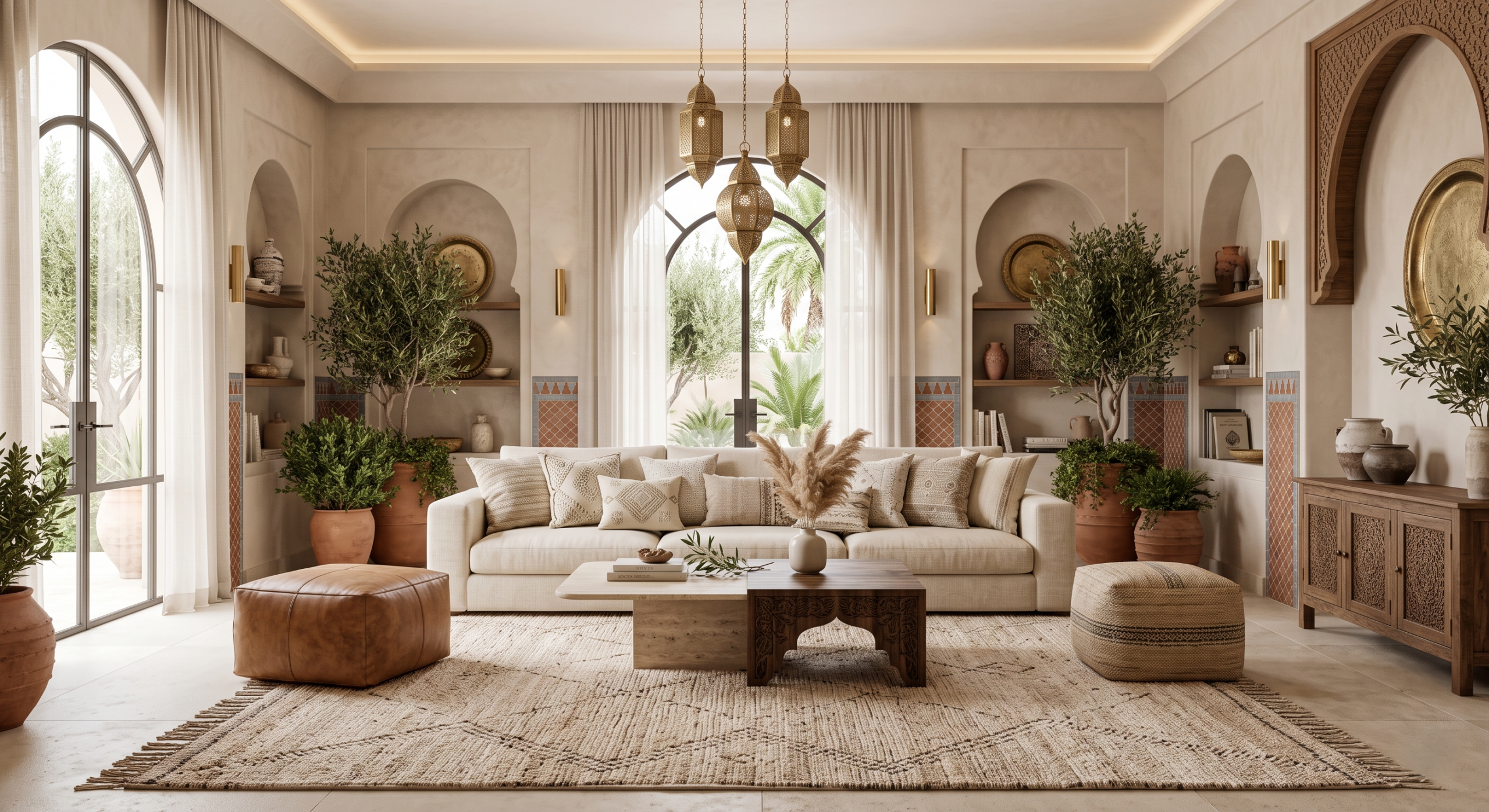
Start With Architecture, Not Accessories
The most common mistake I see is treating Moroccan style as a decorating exercise rather than a spatial one. People buy the accessories first and then wonder why the room doesn’t feel cohesive.
Authentic Moroccan interiors are defined by their architecture — arched doorways, carved plasterwork, intimate alcoves, double-height ceilings with ornate wooden beams. You may not have any of these in your existing space, and that’s fine. But you need to acknowledge what your room’s bones actually are before deciding how far to push the aesthetic.
If your living room has low ceilings, standard rectangular windows and no architectural detail, a full Moroccan treatment will feel forced. In that case, the approach should be Moroccan-influenced rather than Moroccan — drawing from the palette, the textures, and select key pieces without attempting to recreate a riad.
If your space has height, interesting ceiling lines, or existing arch details — as many villas in the Middle East and Mediterranean do — you have a genuine foundation to work with and can push further.
The Palette: Richer Than You Think, More Restrained Than You’d Expect
Moroccan colour is often misunderstood. People reach for terracotta and cobalt blue because those are the most photographed combinations, but authentic Moroccan interiors are actually more nuanced.
The base palette is almost always neutral — warm whites, aged plaster tones, sand, raw linen. Colour comes in through accents: the jewel tones of zellige tilework, the saffron or burgundy of a handwoven rug, the verdigris of hammered copper. The ratio matters enormously. Think 70% warm neutrals, 20% earthy mid-tones, 10% jewel accent.
For walls, I consistently recommend a warm off-white or a tadelakt-inspired finish rather than painting them a saturated colour. Tadelakt is a traditional Moroccan lime plaster with a polished, slightly luminous surface and it immediately shifts the atmosphere of a room in a way that standard emulsion simply cannot.
The Non-Negotiable Elements — Used Selectively
If you’re going to commit to a Moroccan-inspired living room, certain elements are load-bearing. Not all of them, and not all at once — but omitting all of them produces something that reads as vaguely Mediterranean at best.
A quality handwoven rug. This is the single most important purchase in a Moroccan interior. A Beni Ourain rug — the cream-coloured Berber rugs with irregular diamond patterns in dark brown or black — works in almost any contemporary interior because its palette is neutral. It anchors the room and does more atmospheric work than any accessory.
Brass or copper metalwork. Not chrome, not brushed nickel. Moroccan metalwork is warm-toned — hammered brass lanterns, copper trays, bronze hardware. One or two well-chosen pieces are enough. A single large pendant lantern over a coffee table area is more effective than six small lanterns scattered around the room.
Carved or pierced detail. This can be a side table with geometric fretwork, a mirror with an ornate frame, or a screen used as a room divider. It introduces the geometric and arabesque vocabulary of the style without overwhelming the space.
Layered textiles. Moroccan interiors are tactile. Kilim cushion covers, wool throw blankets, embroidered pouffes – these add the warmth and richness that makes the style feel lived-in rather than staged.
What to Leave Out
This is where most Moroccan-inspired rooms go wrong — not in what they include, but in what they fail to edit out.
Avoid mixing every Moroccan motif simultaneously. Zellige tiles, arabesque wallpaper, a mashrabiya screen, painted furniture, and a tiled fireplace surround in the same room is too much. Choose one architectural or surface statement and let everything else support it.
Avoid cheap lanterns in large quantities. The cluster-of-lanterns look has been done to death on Pinterest, and the budget versions look exactly like what they are. One quality lantern is worth ten poor ones.
Avoid overly saturated walls. A deep cobalt or burnt orange accent wall feels like a shortcut — and reads as one. If you want colour, put it in the rug, the cushions, or the tilework, not the architecture.
Avoid synthetic materials. Moroccan design is rooted in craft and natural materials — wool, leather, brass, clay, lime plaster, cedar wood. Polyester velvet cushions and plastic lanterns kill the atmosphere regardless of their shape. This is a style where material authenticity matters more than most.
The Furniture Strategy
Moroccan furniture sits low to the ground. Traditional seating — the banquette-style sofa known as a jilaba, or low cushioned seating arranged around the perimeter of a room — creates an intimate, horizontal quality that is central to the aesthetic.
In a contemporary interpretation, this translates to choosing sofas and chairs with lower profiles than typical Western furniture. A low-slung sofa in a warm linen or textured fabric, paired with a large Beni Ourain rug and a solid wood or brass coffee table, gives you the right proportions without requiring a full traditional seating arrangement.
Coffee tables in carved wood, brass tray tables on folding stands, or solid plaster side tables all work well. Glass and chrome do not.
Bringing It Together
A well-executed Moroccan-inspired living room is not a maximalist exercise — it’s a carefully edited selection of elements that share a common material and tonal language. The rooms that work are the ones where you can feel the logic: warm neutrals grounding the space, one textile statement anchoring the floor, metalwork providing warmth and light, and craft details visible in the objects rather than plastered across every surface.
Start with the rug. Then the lighting. Then the textiles. Add architectural detail last, only if the space genuinely supports it.
Restraint is the thing nobody tells you about Moroccan design. The most beautiful riads in Marrakech are full of negative space — bare plaster walls, simple wooden furniture, a single tiled fountain. The richness comes from the quality and craft of what is there, not the quantity.
That principle translates anywhere.
Have a project in mind or questions about specific products? Get in touch via the contact page or drop a comment below.