


Modern Arabian Interior Design: Balancing Tradition With Contemporary
Arabian interior design is having a global moment — and for good reason. As design culture increasingly pushes back against the sterility of pure Scandinavian minimalism, interiors rooted in warmth, craft, and cultural depth are finding a much wider audience. Arabian design offers all three in abundance.
But there’s a version of this aesthetic that gets it badly wrong — either frozen in a kind of heritage theme park pastiche, heavy with camel motifs and oversized brass urns, or stripped so far in the direction of “contemporary” that the cultural identity disappears entirely, leaving something that could be from anywhere.
Getting the balance right requires understanding what Arabian design actually is at its core — not as a decorative style, but as a spatial and material philosophy.
What Arabian Design Actually Means
Arabian interior design isn’t a single unified tradition. It draws from a geography that spans the Gulf states, the Levant, North Africa, and the Arabian Peninsula — each with distinct regional expressions. What unifies them is a set of shared values: hospitality, sensory richness, a deep relationship with natural materials, and architecture designed around social gathering and privacy simultaneously.
In the Gulf context specifically — which is the most relevant for contemporary interpretation — the design tradition reflects a culture where the majlis, the formal reception room, was the heart of the home. It was a space of generous proportion, rich surface treatment, and deliberate comfort. Not opulence for its own sake, but opulence in service of the guest.
Contemporary Arabian design takes these values and reinterprets them through a modern spatial and material lens. The goal is a home that feels unmistakably rooted in its cultural context while functioning as a genuinely liveable, contemporary space.
The Architectural Foundation
More than almost any other design tradition, Arabian interiors are shaped by their architecture. The contemporary interpretation works best in spaces that have — or can be given — certain qualities.
Volume and height. Traditional Arabian architecture favoured generous ceiling heights, double-volume spaces, and dramatic proportion. In contemporary terms, this translates to resisting the temptation to fill every corner and surface. Empty space is not wasted space — it’s breathing room that gives the room its sense of calm grandeur.
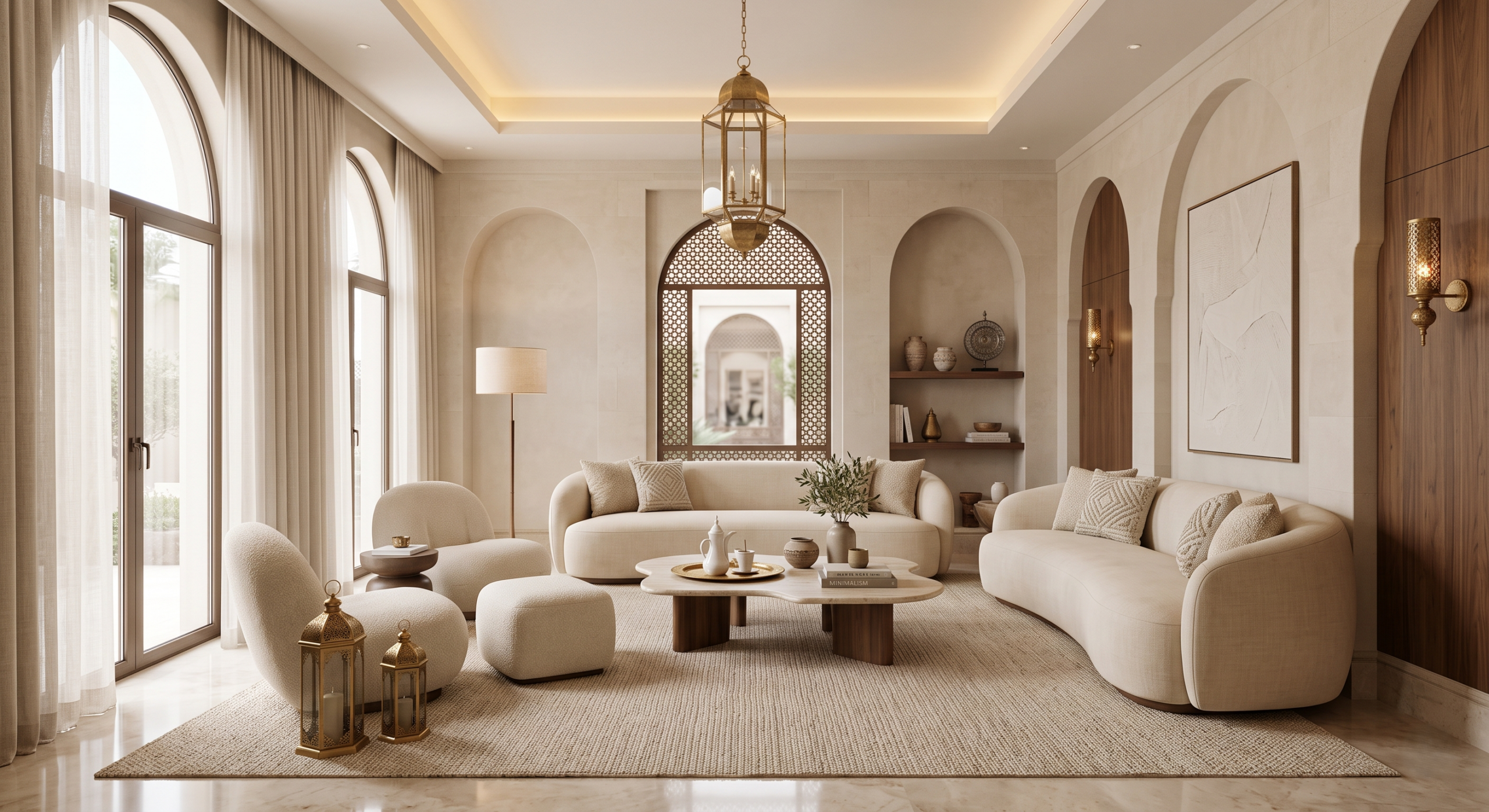
The interplay of light and shadow. Mashrabiya screens — the carved or latticed wooden or plaster partitions traditional to Arabian architecture — were originally designed to filter harsh sunlight and create privacy. In contemporary interiors, this principle translates beautifully: use screens, slatted panels, or perforated metalwork to cast patterned light across walls and floors. The effect is dramatic and deeply atmospheric without requiring any additional decoration.
Defined zones for gathering. The majlis concept is worth preserving in some form. Rather than an open-plan living room with furniture arranged vaguely in the middle, consider creating a defined seating area — a conversation zone that feels deliberate and generous, with enough seating to accommodate a group comfortably. This is the spatial logic of Arabian hospitality translated into contemporary residential design.
Palette: Grounded in the Landscape
The colour palette of contemporary Arabian design is drawn directly from the natural landscape of the region — and it’s far more sophisticated than the beige-and-gold clichés suggest.
Think of the colours of the desert at different times of day: the warm cream of dune sand, the deep ochre of sandstone cliffs, the dusty rose of evening light on ancient mud-brick architecture, the chalky white of coral stone buildings along the coast. These are the base tones.
Against them, introduce deeper accents drawn from traditional craft: the deep indigo of hand-dyed textiles, the forest green of aged copper, the near-black of charred wood, the warm terracotta of unglazed pottery.
Gold has a place in this palette — but used as an accent in metalwork and hardware, not as a dominant tone. A room that reads as primarily gold quickly tips into the theme park territory mentioned earlier.
For walls, warm plaster finishes — either genuine lime plaster or high-quality plaster-effect paint — are consistently more effective than standard painted drywall. The slight texture and depth of a plaster surface catches light differently throughout the day and contributes enormously to the atmospheric quality of the room.
Materials: Where the Tradition Lives
If the palette is the colour of the landscape, the materials of Arabian design are the craft of the culture. This is where contemporary interpretations most often fall short — reaching for visual approximations of traditional materials rather than the materials themselves.
Stone. Marble has always had a place in Arabian architecture, particularly in the Gulf. Warm-toned marbles — creamy whites, honey-veined beiges, soft greys — work far better than the cool Carrara white that dominates European design. Travertine is an excellent choice: its natural pitting and warm tone sit comfortably within an Arabian palette, and it works as flooring, cladding, and surface material.
Wood. Cedar, walnut, and darker hardwoods feature prominently in traditional Arabian craft — in carved doors, coffered ceilings, and furniture. In contemporary interiors, solid wood furniture with simple, substantial forms carries this forward without requiring carved decoration. Avoid light-toned woods like pine and ash, which read as Nordic rather than Arabian.
Brass and copper. These are the metals of the tradition. Unlacquered brass — which develops a natural patina over time — is preferable to the high-polish brass that looks almost synthetic. Use it in lighting, door hardware, cabinet handles, and decorative objects. Avoid mixing with chrome or brushed nickel in the same space.
Handwoven textiles. Kilim rugs, embroidered cushion covers, woven wool throws — the textile tradition of the Arab world is extraordinarily rich. A large-format geometric rug in warm tones anchors the room and introduces pattern in the most natural possible way.
The Furniture Approach
Contemporary Arabian furniture is characterised by substantial, grounded forms — low to mid-height seating, solid construction, simple silhouettes with decorative detail in the material rather than the shape.
Avoid furniture that reads as aggressively modern — thin metal legs, transparent acrylic, high-gloss lacquer. These materials have no relationship to the tradition and create visual dissonance regardless of how well-designed they are individually.
The most effective approach is a neutral contemporary sofa in a warm linen or textured fabric, paired with traditional craft pieces — a carved wooden side table, a hammered brass tray table, a ceramic lamp base. The contemporary pieces provide liveable comfort; the craft pieces provide cultural grounding.
Cushions deserve particular attention. A sofa dressed with kilim cushion covers, embroidered textiles, and a wool throw immediately shifts its register. The sofa itself can be entirely contemporary — it’s the textiles that do the cultural work.
Pattern and Geometry
Geometric pattern is one of the most recognisable elements of Arabian design — the complex, mathematically precise tessellations found in tilework, plasterwork, woodwork, and textiles across the Arab world.
In contemporary interiors, the key is to use pattern architecturally rather than decoratively. A geometric tile floor or a single tiled feature wall carries far more weight and authority than geometric pattern scattered across cushions, curtains, wallpaper and accessories simultaneously.
Choose one primary surface for pattern — the floor, a fireplace wall, a bathroom — and let everything else remain calm. This is the same principle that governs great traditional Arabian architecture: the most ornate surfaces are set against plain plaster, so the decoration has somewhere to breathe.
What to Avoid
The heritage hotel trap. Many designers default to an aesthetic that looks like a Gulf heritage hotel lobby — oversized brass urns, heavily carved furniture, excess chandeliers, deep jewel-tone walls. This reads as institutional rather than residential, and dates quickly.
Mixing Arabic calligraphy as decoration without context. Framed Arabic script or calligraphy-patterned wallpaper is frequently used as a shorthand for Arabian identity. Used without cultural knowledge or sensitivity, it tends to look superficial. If calligraphy features, it should be genuinely significant — a verse, a phrase — not purely aesthetic.
Over-gilding. Gold accents read as luxury when used selectively. When used throughout — gold ceiling details, gold furniture legs, gold accessories, gold light fittings — the cumulative effect is exhausting rather than elegant.
Ignoring the ceiling. Arabian architecture paid enormous attention to ceilings — coffered wood, painted plasterwork, geometric patterns. In contemporary interiors, the ceiling is almost always neglected. Even a simple detail — a ceiling rose, a perimeter plaster band, warm indirect lighting — acknowledges this tradition and immediately elevates the space.
Bringing It Together
The contemporary Arabian interior at its best is a room that feels rooted — in climate, in culture, in craft — while functioning completely as a modern home. It achieves this not by reproducing traditional elements literally, but by understanding the values behind them: generosity of space, warmth of material, richness of surface, and a quality of light that shifts and softens throughout the day.
The shortcut version of this aesthetic produces rooms that look like they were assembled from a mood board. The considered version produces rooms that feel like they belong to someone — to a place, to a history, to a way of living that has genuine depth.
That difference is always visible. And it always comes down to restraint, material honesty, and understanding the tradition well enough to know which parts of it are worth keeping.
Designing a space with an Arabian aesthetic? Every project has its own constraints and possibilities — feel free to reach out through the contact page.